

Event Roundup: AI Adoption in the Workplace
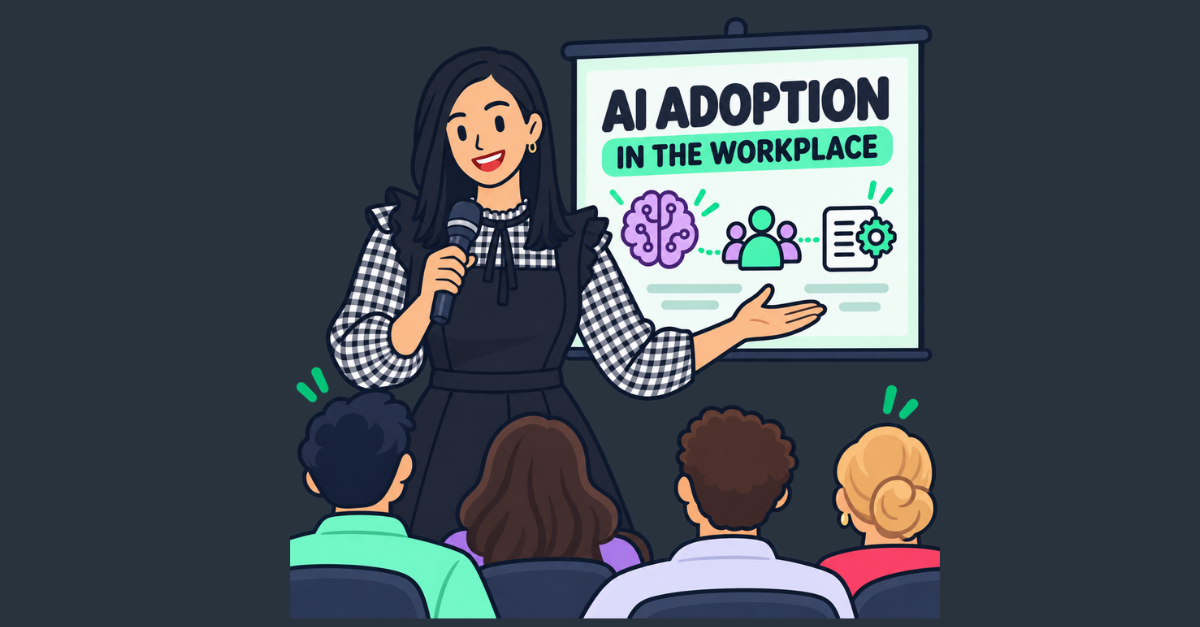
From Strategy to Reality
What happens when AI moves beyond strategy and starts changing how people actually work?
That question was at the heart of From AI Strategy to Reality: Challenges and Lessons from Life Sciences, an event I had the pleasure of hosting as part of Leeds Digital Festival.
There is plenty of conversation about what AI could do. This discussion focused on the reality of implementing it: the impact on people, roles, skills, culture and leadership.
Although the examples came from life sciences, the lessons around AI adoption in the workplace are relevant to organisations across sectors.
How will AI change jobs and software development?
One idea that stayed with me was the Jevons paradox: when efficiency makes a resource cheaper to use, demand can increase enough to outweigh those efficiency gains.
Could something similar happen with software development?
If AI makes development faster and more affordable, the outcome may go beyond producing the same software with fewer people. Organisations could build more of it, tackling problems that previously would not have justified the investment.
Smaller projects, more tailored tools and previously overlooked business needs could become viable.
That possibility changes the conversation about AI and jobs. Alongside asking which tasks AI might replace, we should ask:
How will the value people bring to their roles change?
Human judgement becomes more important
As AI takes on more execution, people may spend more time directing, reviewing and assessing its work.
For software teams, that could mean less time manually writing every line of code and more time deciding what to build, testing its suitability and taking responsibility for the result.
Across an organisation, people still need to identify worthwhile problems, provide context and challenge outputs.
That makes judgement, curiosity, critical thinking and communication essential. As Rebecca Herbert and Katy Gooblar explored during the evening:
Soft skills aren’t really soft skills anymore. They’re core skills.
Technical expertise remains vital. The ability to apply it thoughtfully, communicate decisions and recognise when an answer is wrong matters just as much.
Successful AI adoption starts with people
Giving employees access to AI does not automatically mean they will use it effectively.
Adoption means changing established habits, building confidence and sometimes questioning processes people have relied on for years.
Organisations need to ask:
- Do people understand why AI is being introduced?
- Do they know where it can help and where its limits lie?
- Can they challenge an output without feeling uncomfortable?
- Do they have the training, support and time to learn?
People need confidence to question the technology and recognise when human review is necessary.
Communication and trust are central to making that happen.
Build a learning culture around AI
Another useful distinction from the evening was between a knowledge culture and a learning culture.
In a knowledge culture, someone’s value can become closely tied to what they already know. Technology that can generate answers quickly may understandably feel threatening.
A learning culture places value on people’s ability to adapt, ask better questions and use new tools effectively.
Building that environment takes more than buying an AI licence. It requires clear leadership, support and opportunities to experiment within appropriate boundaries.
Leaders need to go first
If leaders want teams to experiment, they need to demonstrate that behaviour themselves.
That means trying tools, sharing lessons and being honest when something does not work.
One message from the evening captured this well: you either succeed, or you learn.
People will quickly stop experimenting if every unsuccessful attempt is punished. Psychological safety gives teams space to raise concerns, acknowledge mistakes and improve how they work.
Look beyond immediate productivity gains
During the discussion, we heard examples of faster code reviews, fewer bugs and development projects completed in substantially less time than originally estimated.
These were experiences shared at the event, rather than results every organisation should expect. But they raised an important question about how businesses use any capacity AI creates.
The immediate response might be to ask how to deliver the same work with fewer resources.
There is another opportunity worth exploring:
What can we now do that we previously couldn’t justify doing at all?
That could mean addressing a neglected customer need, improving an internal process or giving teams more time to solve difficult problems.
Find the gaps between strategy and everyday work
One phrase from the evening particularly resonated:
“The space between hides waste and opportunity.”
Friction often sits between teams, systems and decisions. It appears where leadership expectations do not match everyday working practices, or where a promising pilot never becomes part of a usable process.
To make AI adoption meaningful, organisations need to examine those gaps.
Where do handovers slow things down? Where is context lost? Who is responsible for checking an output and acting on it?
Answering those questions can be as important as choosing the technology.
What does AI adoption mean for hiring and talent?
At Boost Talent, we speak with technology leaders about the skills their businesses need and with people considering the next stage of their careers.
AI is changing both conversations.
Alongside technical capability, employers need to consider how candidates:
- Ask questions and provide useful context.
- Critically assess AI-generated work.
- Communicate decisions and challenge assumptions.
- Understand consequences and exercise judgement.
- Learn and adapt as tools and responsibilities evolve.
These qualities also deserve attention when developing existing teams.
AI adoption in the workplace is a people transformation as well as a technology transformation. Hiring, training and leadership need to reflect that.
From AI strategy to the next practical step
My biggest takeaway was that tools alone will not determine success. The environment organisations create for people to learn, question and use those tools will matter enormously.
Thank you to everyone who spoke, shared their experiences and joined such an open conversation.
At Boost Talent, we want to keep bringing people together to explore what is happening inside businesses and learn from one another.
Thinking about how AI is changing your team’s skills and hiring needs? Get in touch with Boost Talent to discuss the people and capabilities your business needs next.
And, as we were asked at the end of the event: what will be your first next step?
Ready to build a team that performs at its best?
From attracting exceptional talent to developing leaders and strengthening your culture, Boost Talent helps your people and business grow. Let’s talk about what your team needs next.